Thursday, July 28, 2011

A Guided Tour of the World of Experiments

Time has gone by so quickly! I am still in shock that tomorrow is my last day of class. Even thought we are so close to the end, we continue to learn more about the way experimental physics works in the real world. One thing that has changed in the final couple days is that we are beginning to learn about it from many different sources. In addition to the guest lecture today I heard from my fellow classmates (and got to teach them a thing or two myself) as well as some of the grad students that populate the basement of our building, working on some groundbreaking studies with radio telescopes, carbon nano-tubes, and soft matter.

The day started off with a very interesting guest lecture about the construction of SNO (Subdury Neutrino Observatory), a huge neutrino detector placed at the bottom of a nickel mine to shield it from unwanted background information. By studying these subatomic particles that can travel the distance between us and the sun in just over eight minutes, we can learn a lot about the nuclear reactions occurring at the suns core currently. It turns out the data also proves the Standard Sun Model, which had previously been questioned because previous experiments did not account for oscillations that can change the "flavor" of neutrinos. The most interesting part of the lecture for me was seeing the journey from the first detector that failed to collect conformational data and the confusion that insued, to the construction of SNO and the steps that led scientists there. That is truly what experiments are all about: dealing with confusion.

Another great part of the day was listening to the experiences and findings of the classmates who worked on different interest groups than me. Groups gave presentations on cloud chambers, measuring cosmic rays, using radio telescopes, and a number of other really fascinating things. Something really exceptional about the presentations was not the data they got (although sometimes, when they came really close to the accepted value that was also neat) but the experimental process that each group preformed, and in some cases designed.


To be completely honest, my favorite part of the presentations was the part where my group got to share our experience with quantum mechanics and electron/photon diffraction. It was a really cool feeling being able to tell a group of people about the data that we collected ourselves and the significance of it, especially because particle/wave duality is such a mind-bending phenomenon that is crazy just to think about, let alone explain. My group faced the challenge quite elegantly and we sat down knowing that each of our peers knew a little bit more about the amazing concept that we could prove with our own data.

After lunch, we went on a tour of the grad labs, which gave me more of an idea of what the field of physics actually looks like than anything we've done in class before. Young students with excited smiles and scraggly beards showed us the equipment they worked with and explained to us why they were interested in the field they were currently researching. It was clear it was a lot of hard, and possibly tedious work, but it was also clear that each of them was genuinely excited about what they were doing and confident that the work they were doing was both significant and completely awesome. It was an environment I can see myself fitting right into.

Our PENNultimate Day

Today was exciting from the start because we began our class with a talk with Rick Vanberg. For the first few minutes I munched on my bagel and listened, but soon his talk became quite captivating. The first thing that Rick talked about was the standard nuclear model for the sun. Based on the observations of nuclear activity on small scales, scientists came up with a model that accounted for the gravity, high pressure, and high nuclear activity in the center of the sun. One problem was that the accepted model at the time predicted a large number of neutrinos would be released for every fusion reaction in the sun.

Because there are so many reactions every second, scientists predicted a certain number of neutrinos per second would hit each meter of the Earth’s surface. To test this model, a scientist filled a large vat full of liquid and then waited for a while. Although the experiment was underground, neutrinos are tiny and have no charge so they very rarely interact with the matter in the way. When the neutrinos strike the liquid, they are absorbed and they change the atom that they strike into a different element. When he took the measurements of the number of neutrinos that he detected, he found that there were only about 28% of the neutrinos that there should be.

To solve this conundrum which either implied that our model of the sun was totally wrong or that we didn’t understand neutrinos, a Russian scientist stepped up to the plate. Communicating through the veil of the Iron Curtain, this scientist published several papers where he claimed that we misunderstood the neutrino. To test this claim, a project called SNOW was developed. Snow basically consisted of a huge neutrino detector built to detect all kinds of neutrinos unlike the past models. To filter out background radiation, SNOW was built 2 kilometers beneath the surface of the Earth in a nickel mine in Ontario. SNOW ended up successfully measuring all of the neutrinos that came from the sun and we learned that the neutrinos were being morphed into other flavors and that the nuclear model of the Sun is actually correct.

Next on our schedule were the student focus group presentations. Each of us spent 4 days last week with our groups researching a subject that we picked. My group studied a non-Newtonian fluid called oobleck which basically means that it is a material that behaves both as a solid and a liquid. The peak of our presentation was on Monday when we used the oobleck in a demonstration. Because oobleck acts a solid when it’s under pressure, each of us could run over it. Today, we showed some graphs of how objects decelerate when they hit oobleck compared to when they hit water. The graphs were neat because you could really see how the oobleck gave away for a moment and then hardened and stopped the incoming solid whereas the water allowed the object to easily pass through. It would be way too much to talk about every other group’s presentation, but they covered many amazing topics such as quantum mechanics and radio astronomy. Each group had a unique perspective to offer and we all learned a lot from each other.

When we returned for lunch, we got to do something pretty interesting. We split into groups and then visited different parts of our building and the one across the street. We got to go into research labs and listen to brief talks by the researchers themselves about what they were working on. The first lab we stepped into was a lab where a grad student and a professor from UC Santa Barbara (WHOO California) were developing technology for better mammograms. Because current mammography methods require the breast to be squished tightly between pressure plates so that the waves could get better images, these researchers were searching for a way to do mammograms with near infrared light. The advantage of this is that the discomfort of the plates could be avoided and therefore more women might show up for their mammograms. I was impressed by how applicable this research seemed and that it truly was for a good cause. We heard many other talks about great stuff like carbon nano tubes and grapheme. These researchers were researching grapheme so that they could manufacture tiny detectors for things such as bomb detection. Overall, I was very impressed by how passionate these researchers were about their areas of study.

I am in shock that tomorrow will be my last day here at UPenn, but who knows; maybe I’ll be able to spend another 4 years here.

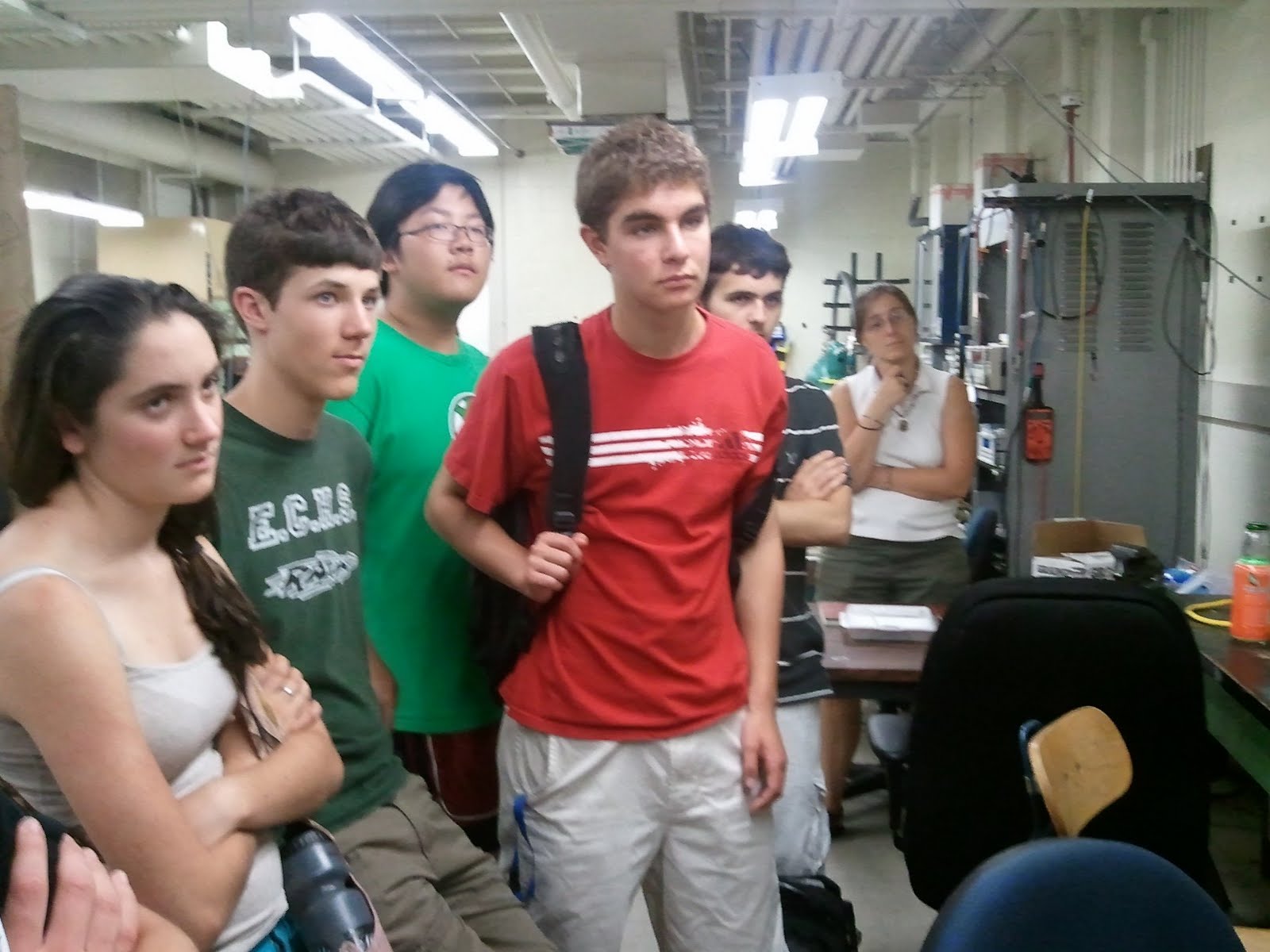
Thanks to Alex for capturing Julia's momentary lack of enthusiasm.

The Day is Almost Here...

Today was much less intense than the past couple of days. We began with a lecture from a well known particle physicist, Rick Van Berg. Rick primarily designs detectors for particle physics experiments. He has done a lot of work in the Cern Laboratories in Switzerland, home to the smartest scientists of this age and the best particle accelerator in the world. Lately, he has been working in the SNO facilities in Ontario, Canada. SNO stands for Sudbury Neutrino Observatory and it too is one of the best research facilities in the world. His lecture was actually all about Neutrinos, which is a basic particle that usually travels close to the speed of light, can pass through most matter unaffected, and is electrically neutral. He discussed the origins, discovery, and research of neutrinos and it was all fascinating. For instance, the SNO facilities are basically giant clean rooms, much like facilities in which they produce computer chips in. Professor Van Berg told us that if even a teaspoon of dust were to be introduced to the facility, every project would be ruined. I always find the stipulations that are put on certain research environments interesting. I like seeing all the effort that scientists and researchers are putting in to reduce their possibility for error as much as possible. Professor Van Berg covered one of the more difficult and complex lectures, but his was much more understandable than some of our other lectures.

After lecture, we continued with our presentations. I was very excited to watch these demonstrations because I wanted to see what kind of work my friends and peers had been doing for a week. I was also anxious to see how our data and experiments would stack up against theirs. When it came down to it though, our topic was quite different than most of the other groups’. While most of the other groups were doing experimentation for the majority of the week, we were being given lectures about radio astronomy and the tools used to study it. This was completely understandable though. Although we did not do many experiments, we needed to know how everything worked before we could understand what exactly we were doing before we could actually do it. This really made our presentation stand out because our data section was short, but our general and background information was much more extensive than the other groups’. Mary told us at the beginning of lunch that she though our presentation was a nice change from the rest and that our information was plentiful and well-organized.

Following lunch, we split into four groups to tour different labs around DRL. I didn’t realize that there were so many different kinds of research going on in the DRL. We visited medical labs, cosmology labs, and even soft-condensed matter labs, which deal with matter that has both the properties of liquids and solids. Mostly, we spoke to grad students that were doing research in the lab. They were able to tell us all about the projects they were working on. One of the most interesting projects we saw (in my opinion anyway) was a machine that was being developed that would use near-infrared waves to sense tumors. The research was mostly focused on improving scans for breast cancer, but it was also applicable to scanning other tumors and also brain activity. It was truly amazing work. Of course each of the labs was showcasing the best of what they were working on and each of them told us why their specific field of research was one of the best. It was interesting to hear about the different research styles and opportunities that all of these grad students have. It was even better to hear that undergrads are also allowed to study in these labs and perform research. Our visits to these labs were truly enlightening because it gave me an even better glimpse of what kind of research opportunities I could potentially have in college.

Sample data collected by grads and undergrads

Professor Van Bern discussing ATLAS, another project he worked on

After class, I continued packing a little bit. I’ll finish tomorrow before the room check, but it’s definitely not something that I am looking forward to. Once 6:00 came around, my floor and our RC, Carlos, went out to Bobby’s Burger Palace for a group dinner. Apparently the Bobby, after which this restaurant is named, is THE Bobby Flay. I didn’t realize this until we walked inside and there was a whole section of the counter dedicated to Bobby Flay marinades, spices, and cookbooks. The food was amazing as well. It was just a burger and fries, nothing too extravagant, but it was just so delicious. The burger was cooked to perfection and the fries were perfect. I couldn’t imagine a better way to come together as a floor. We all took a group picture out front, but we only had time for one shot because we had to be back at the quad as a group before a certain time. Unfortunately my camera was not the one used, but my friend and floormate Sachit’s. He will be uploading the picture to Facebook soon and I will be sure to use the shot in my reflection blog.

Everyone approves of Bobby's


We returned to the quad and got as much of the group together as we could. Since this is our last full night here at Penn, we wanted to enjoy our final moments hanging out in our lounge-like dorm. Although Fred, Abheek, and Julia were busy, Alison, Brian, Onur, and I still had a great time. We talked, we laughed, but most importantly we just enjoyed each other’s company. Being together in the dorms and lounges is what I’m going to miss the most about being at Penn. These nights were often the highlights of my days and I will always treasure the moments I’ve had in our little family of seven. The end is near.

One day remains.

A different take on Vettriano...

Wednesday, July 27, 2011

A Unifying Theory

We got right to work today with a morning lecture about nuclear physics from Ryan, one of the very helpful and knowledgeable assistant teachers. The first couple slides were about the history of nuclear energy and the discovery of x-rays. Ryan went on to explain the physics behind alpha decay, beta decay, and gamma radiation (during this part of the presentation, our previous lecture about the standard model came up again and it was necessary to recall the concept of leptons and quarks). The remainder of the lecture was devoted to explanation of applications of radiation that are highly important both within and independent of the realm of physics. We discussed the benefits and waste products of uranium mining, the breakthroughs and limitations of radiation as a cancer treatment, briefly touched on the subject of mass spectrometry and how radiation can be a helpful tool in studying the origins of the universe. Towards the end, the lecture transformed into more of a discussion that was so lively and obviously relevant, that I found myself more engaged than I had been during any previous first-thing0in-the-morning lectures.

After Ryan's talk, we were given a short break to let the information soak in a little and to give us time to prepare for our presentations of the Hershey Park Rides. It was a very different experience hearing from groups of fellow classmates as opposed to professors and teachers. Each group went on a different ride, so the data was unique in that regard, but each team's presentation and analysis of data varied greatly as well. Some groups were able to record videos and sync them to their data, others calculated the resultant total acceleration based on the x, y, and z values they collected. One group even had a three dimensional animation of altitude v. y acceleration v. time. By the end of the day, I had learned a lot from my fellow class mates about creative ways to handle data in a way that makes sense to your particular experiment and goals.

When all the presentations were over and we returned from our lunch break, we prepared for our guest lecture by watching "Elegant Universe", the PBS show on string theory. As I was watching, I realized that I had seen parts of the show before; my fifth grade teacher played if for our class. At that time it had come out only a few months ago. I remembered the movie distinctly because it was a moment in my life when I realized both how incredibly cool science could be, and at the same time, how very little I understood about the complexities of it. Watching the film this time around, I understood many more of the concepts, but the sense of wonder was not lost.

Only moments after watching the program he was quoted in, we got to hear from string theorist Burt Overt himself. He described to us, in much greater detail than the movie, the basic concepts of string theory, the implications that the theory has, why it makes sense in the real world, and the ways in which it can be tested.

The basic definition of string theory is the hypothesis that the smallest components that make up the universe are not particles but tiny strings that vibrate at different frequencies to create different kinds of matter. The mathematical calculations that have been done suggest that such a theory means that there must be 6 other dimensions besides the three spacial dimensions and time. The concept of extra dimensions is a hard one to grasp, but it made more sense to me today than it ever has before when Dr. Ovurt did a demonstration with a rolled up piece of paper. Another implication of string theory he discussed was the concept of supersymmetry, meaning that for every particle, there is a so-called "sparticle" that also exist. These particles have yet to be found because they do not appear in low-energy circumstances, but Ovurt has high hopes that CERN will provide the environment necessary to make significant breakthroughs in the subject.

It was fascinating listening to an expert talk about a field that is at the very outer edges of the scientific frontier. The fact that people in the class asked questions that no one in the world has answers to, but that Ovurt is actively working on discovering was almost too much to comprehend.

After class, we had a few hours to wander campus before we went out to dinner with Mr. Miranda and the Yale chaperone. We ate at City Tavern, a place I had been interested in visiting since our initial tour of the city. The food they serve is all based on the typical cuisine of the taverns of the 18th century that our country's founders used to eat. While we munched on some sweet potato pecan rolls (apparently one of Thomas Jefferson's favorites) we discussed not the past, but the future: our plans for senior year, applying to colleges etc. When dinner was over, we visited an ice cream parlor, a great end to one of my last days here at Penn.

Today Was Truly a Rollercoaster...

Our final days in class seem to be getting more and more complicated. Today we began class with a lecture from Ryan on nuclear physics. The subject material was confusing at first, but he was able to make it accessible. He told us that this was one of the most important topics that is almost never covered in high school physics classes. Since this is an issue that will invariably affect all of our lives. Nuclear reactors and energy has been an issue for several decades and, with the approach of peak oil and the need for alternative energies, will continue to be an issue in the coming years. Since this is a prominent issue, people my age need to be informed of just how nuclear physics works so they can make informed decisions. With that said, I found his lecture to be quite informative. One of the points that Ryan made that I found quite funny was that a plate that one microwaves several times over a long period of time will be more radioactive than a cell phone. Since there is a lot of worry over the radiation given off by cell phones, I found it ironic that people don’t even realize that there is a bigger danger right in front of their noses. This just demonstrates why people need to be informed about nuclear physics. I found that it fit the situation perfectly.

After Ryan’s lecture, we did our presentations on our Hershey Park rides. Our group was the fifth to present (out of eight) and I would say that ours was one of the better presentations. Each of our PowerPoint presentations had their strong suits, whether it was creativity, enthusiasm in the presentation, or being strong in data analysis. One group even produced a 3-D model of their coaster in a graphing application on one of their member’s Mac. All of the groups kept their presentations entertaining as well. The group that was assigned the Great Bear filled their presentation with bear puns (it was almost un-bear-able). I had a great time watching all of the presentations and it made me look forward to the presentations that we will be giving tomorrow.

Our guest lecture followed lunch. Today we were visited by Dr. Burt Ovrut, a string theorist who teaches Theoretical High Energy Physics. String theory is an active research framework in particle physics that attempts to reconcile quantum mechanics and general relativity and is a contender for the theory of everything, a manner of describing the known fundamental forces and matter in a mathematically complete system. That was the definition that Dr. Ovrut gave. In layman’s terms, string theory is the theory of how everything in the universe is tied together by basic elements called strings. In his lecture, Dr. Ovrut discussed the possibility of other dimensions that are parallel to ours and are unreachable, different particles that may exist, such as gravitons and sparticles, and even membranes, which separate the dimensions. The lecture was extremely difficult to follow. The pace of the discussion was non-stop and you either had to keep up or get left behind. I would like to understand string theory better someday, but before then I will definitely need to work a lot harder, and I am prepared to take on that task.

After lecture, Brian and I headed back to the dorm. He began his summer assignment for AP Lang and I decided to begin packing so I don’t have to do all of it on Friday afternoon. It was actually kind of sad because I felt like I was taking apart different pieces of the home that I have built over these three weeks. My desk is much cleaner, my closet and drawers are nearly empty, and my suitcase is about half full. I know I will be glad that I started packing today, but when I was taking down the wall mount I had made for my lightsaber, it was quite saddening. It is still hard to believe that I will be returning to California soon.

Around 6:20, we met Mr. Miranda in the office so he could sign us out for dinner. Much to my surprise, we dined with Ms. Nardone again, the Yale chaperone. We ate dinner at an old fashioned restaurant at Penn’s Landing that was set to the theme of an older Philadelphia, around the time of the Founding Fathers. The attire for employees, decorations in the restaurant, and even the meals felt like they were ripped straight out of a history book. I enjoyed the venison medallions with a starter called mushroom toast. The toast was basically just marinated and grilled mushrooms over a piece of bread that was toasted to the consistency of a crouton. It was delicious and almost as good as my entrĂ©e. I had never had venison before this meal, and it is one of the best kinds of meat I’ve ever had. We also got the chance to get to know Ms. Nardone a little bit better thanks to this dinner. She’s a very interesting and knowledgeable person and I think the Yale group is very lucky to have her as a chaperone. After dinner we stopped by an ice cream parlor called the Franklin Fountain. It is the Philadelphia equivalent of Fenton’s in California. The ice cream was truly amazing and I wish we could have gone sooner. The parlor even had a section in the back with shelves full of vintage soft drinks, including bottles of RC Cola, Dr. Pepper, and several brands I had never heard of before. At first I was sad that I would miss the talent show to go have dinner, but I had a great time and I wouldn’t trade it at all.

A true colonial...kind of...

Ice cream in a Chinese take-out box...I approve

When we returned to campus, we had a meeting in the lower quad to discuss our last few days in Summer Discovery. Ed told us that normal rules would still be enforced, even though some people may think that everything is basically over, and that he didn’t want us to be sent home prematurely just because of something stupid that might be done on the last day or penultimate day. He also told us about our check-out procedure and that our rooms need to be clean by 5:00 on Friday afternoon. We were also given an evaluation form to evaluate the program as a whole and even the Summer Discovery staff that we interacted with the most. After that, the night was pretty laid back, which was more than welcome after the mind-boggling guest lecture and traumatizing experience of packing from earlier today.

Two days remain.

Time's Flying

I stepped into class today with a couple of bagels from the campus bakery and took my seat. I’d have to say that today is the first day where it’s really hit me that I have to go home in only a few days. It’s hard to walk anywhere on campus without seeing a few Ben Franklin quotes, and I think one of the ones that has stuck most is, “When the well is dry we know the worth of water.” I’m realizing now that I only have a few days left here so of anything I’ll try to appreciate them more than any of the others instead of whining about it. Anyways, I was in a very receptive mood for Ryan’s lecture on radioactivity and I think I learned a lot from it.

Ryan first discussed the development of what we know about the atom and how we learned it. This stuff was mostly review for me because of my chemistry classes, but it honestly amazes me every time how scientists such as Thomson and Rutherford pieced together an accurate model of the atom while everyone else thought they were crazy at the time. It also impresses me how each of these atomic models built on the last but did not totally discard. Thomson proposed that there were positive and negative charges in the nucleus and Rutherford discovered that the nucleus is actually a dense positive center. This model was improved on by Niels Bohr where he theorized that electrons orbit the nucleus much like planets do the sun. This was later revised, but the ideas of each of these scientists were still kept in some form.

The next part of Ryan’s lecture was talking about the uses of nuclear energy and a few common misconceptions about it. One of the first things he summarized is how a nuclear reactor works. By packing together fuel rods near each other, the excess neutrons from an atom fly out and then hot another atom which produces a couple more neutrons for each one that hit it causing a chain reaction. Then, what surprises a lot of people is that this energy is simply absorbed and used to boil water. From this point on, the power is generated just as it is in any other power plant; the steam is used to drive a turbine which turns a magnet which creates a current.

One of the first misconceptions that Ryan sought to debunk is that many people think of radiation as dangerous and very negative. What many people don’t realize is that radiation also has many applications that are very beneficial to humans when controlled properly. One of the biggest areas radiation is used to benefit humans is in the medical industry. As I believe Ryan pointed out, the acronym MRI is really missing a letter; it should really be NMRI which stands for Nuclear Magnetic Resonance Imaging. MRI machines use carefully aimed radiation to get something like an X-ray of your body, but 3 dimensional and with a low dose of radiation. Furthermore, radiation can be very carefully aimed at malignant tumors in the body to kill them before they mestastethize. Although this treatment is not always successful, it can help in some cases and is certainly a good application of radiation.

The day only got better as we got further in, because the next part of our day was about string theory. We watched a brief movie on the fundamentals of string theory, and then talk to one of the leading experts in the field, Burt Ovrut. The fact that Burt truly talked to us and didn’t have a lecture prepared made his talk extremely valuable because we could easily tap his brain about any part of the subject we were interested in. The basic premise of the talk was that string theory proposes that the universe is full of tiny vibrating strings that when struck at different frequencies act as the ‘particles’ we commonly observe. I will avoid trying to dump a huge amount of information here, but the reason that string theory is so important is because it could unify all of physics as we know it. Today, physics is a shattered mess of quantum mechanics, general relativity, and a bundle of different forces. String theory is intriguing because when you work out the complex equations, there are simple solutions to these complicated problems. For example, string theory predicts only one force instead of the gravitational, electric, magnetic, strong, and weak forces as we know them today. As Bill always says, it’s only philosophy until there’s solid evidence, there is little evidence to support string theory today. However, the Large Hadron Collider in Switzerland may well find evidence for or against sting theory, and guess what college physics program helped develop some of the detectors for the LHC. That’s right, scientists at UPenn helped. It’s very exciting to be around a place where there is so much progress going on.

Tuesday, July 26, 2011

Traveling at the Speed of Light

Class today was very laid back. We started off the day with our speed of light lab. Since we had already set up our circuits, all that was left to do was line up our laser with a mirror across a dark hall in such a way that it bounced back and hit our second photo receptor just right (the first sensor was placed next to a beam splitter in front of the laser. Both receptors were attached to an oscilloscope so we could determine the delay between the two waves (it came out to about 8 nanoseconds). Because we knew the length that the light had to travel from the first sensor, to the mirror and back to the second sensor, we were able to measure the speed at about 3.4 x 10^8 m/s, which is not too far off the accepted value. We were given two hours to collect our data and make our calculations, but because my group finished early, we had about 30 minutes to kick back before our guest lecture.

It was good we were given that time because after a short break, I was able to give all of my attention to Ken Lande when it was time for his lecture to begin. Dr. Lande spoke to us about the energy crisis, how long our current consumption of petroleum can be sustained, and the effects waste products such as CO2 emissions are having on the environment.

Once he convinced us that an alternate source of energy was necessary, he discussed possible solutions. I was surprised at how inefficient the current sources of green energy are. For instance, in order to power the united states with exclusively solar energy, an area twice the size pf Pennsylvania would need to be covered with solar panels. Even more shocking was the amount of land that would be needed to grow crops for bio fuels to power the country: 1/6 of the area of the United States, which would not leave very much room for agriculture. We also discussed fission reactors, but after the disaster in Japan, people are hesitant to rely on something so potentially hazardous. Additionally, in order to rely on fission reactors for energy, we would need to increase the number of plants we currently have by a factor of five. Dr. Lande maintained that the most promising alternate energy source is wind turbines. Only half a million wind turbines would provide enough energy to free us from our dependence on fossil fuels, which would only cost about $200 million a year (only a fraction of what we spend on automobile gasoline).

I appreciated his lecture for its practicality in the real world, in fact he often teaches classes at Wharton school of Business because there is so much money going into alternate energy sources. No wonder too, it is arguably the most pressing issue the world faces today. Me and Brian discussed its importance and the lecture in depth as we walked to lunch.

When we returned, we were given time to do whatever it was we needed to get done. For me that was working with my Hershey Park group on making a PowerPoint for our presentation tomorrow. We wrote up an analysis, slapped a couple graphs of the data we collected, added a video and called it a day.

After class, I went with a book and read for a while by the coy pond. It was very relaxing and it allowed me to sit back and let time move a little slower for a while. With only three days left, I want to get everything I can out of the time I have.