Friday, July 22, 2011

Great Start to the Weekend

Today, we took another field trip. This was a fine way to end the week, especially considering the intense work that we had to do this week. We traveled to the Franklin Institute via school bus this morning at 9:30, which allowed us to sleep in an hour later. The Franklin Institute is a very diverse place so it is difficult to give it a description that covers all of its bases. At its core, the Franklin Institute is a center for scientific learning for all ages, akin to the Exploratorium in the Bay Area. Although there are definitely aspects of the institute that are geared towards the youth, a good majority of it is dedicated to the principle ideas of science. For instance, there is a large section of the third floor that is used for displaying Newtonian ideas of motion, called Sir Isaac’s Loft. All of the displays in the loft are accessible to children, but all of them have detailed plaques that describe the physics behind each display. There were also live demonstrations that occurred throughout the day in the main atrium. The idea of the Franklin Institute is great because it takes even some of the more difficult principles of science and makes it easy for a person of any age or scientific background to engage in learning and walk away with more knowledge than when they entered.


The US's version of Big Ben

I did a lot of things while in the institute today. We began by taking a group shot of the class in front of a massive statue of Ben Franklin (which looks shockingly similar to the Lincoln Memorial) and then observing a giant pendulum in the main stairwell. The purpose of the pendulum is to show that the Earth rotates upon an axis. The pendulum is hung in such a way that it continues the same path of motion while passing through a ring of chess pieces that, as the day passes, will be knocked over by the pendulum. After that, we were basically on our own until 12:30, which is when we would meet for lunch. I spent most of my time touring the museum with Mike, while occasionally joining, leaving, and re-joining Brian and Julia. As we walked around the institute, I realized how much I have learned in my science classes these past couple of years. I remember visiting places similar to the Franklin Institute and only being interested in the fascinating displays. However, as we toured the institute, I was easily able to identify what scientific principles were at work, from concepts such as mechanical advantage as well as laws relating to gas and pressure.


Taking the phrase "worked to the bone" a bit too seriously...

The highlight of today’s learning came after lunch, when our class gathered in the planetarium for a show about black holes. I was able to apply what we had learned in our lectures on relativity. I even recognized some of the demonstrations that we did in class to represent what actually happens when a black hole is formed. Basically, a black hole is the result of a massive star that goes supernova and leaves a deformation in space-time, from which nothing, not even light, can escape. This is why black holes were given their name. They absorb all light which leaves the area devoid of any light whatsoever, resulting in total darkness. Black holes actually have a point of no return called the event horizon. The demonstration was fascinating and helped me put my previous lessons about relativity into a better perspective. After the show, we were once again allowed to roam the institution. I chose to use some of this time in the gift shop, where I bought some souvenir t-shirts and gifts for my family.

The rest of the day was just spent relaxing. Upon our return from the Franklin Institute, I promptly made my way up to my dorm so I could sit in the air conditioning for a while (it was one-hundred and two degrees at one point this afternoon!). We only had a couple of hours between when we arrived and when we would have to meet for our weekly movie. I decided to hang out in the dorm with Onur, Brian, and Fred until dinner. We met with our peers (at least one-hundred of them) in the quad at about 7:00 to go see Harry Potter and the Deathly Hollows, Part Two. I’ve never been a big fan of the Harry Potter films (the novels are a different story though), but there was something special about watching the finale to a series that has been popular for a good portion of my adolescence. It was interesting to watch people react to the end of this era because there were some die-hard Potter fans in the audience. I was even shushed by someone sitting in front of me within the first two minutes of the movie because I asked Brian (who was sitting right next to me) who a certain character was. Pop culture can be very interesting sometimes…

Today was an excellent way to kick off the weekend. We will be going back to Center City tomorrow to walk around the city without being rushed. We will also revisit Love Square so we can buy some souvenirs. This will be my last weekend with my Philly family, so I am sad about that. However, we are all aware of this and intent on making our final weekend together as memorable as possible.


Excuse me sir, you seem to be double parked...

Good to know??

Cool People on a Hot Day

Everyone loves Friday because it’s the end of the working week and the beginning of some time for a bit of relaxation. I look forward to Fridays here at UPenn because every Friday we go on a class field trip to various locations in Pennsylvania. Today, after some breakfast and a shower, we all boarded a yellow school bus just as the temperature was getting to be unbearably hot. The ride was extremely hot, but mercifully it was a short trip to our destination – the Franklin Institute-. The Franklin Institute was founded in Philadelphia where Franklin did most of his work to commemorate the achievements of Ben Franklin and to share an interest in science with younger people. Once we arrived, Bill handed out admissions tickets and lunch vouchers and soon enough we were all of exploring the museum’s many exhibits.

The first exhibit that I explored in depth was the biology exhibit about the heart. One of the most interesting parts of this exhibit was a large revolving display that had models of the hearts of many animals, from hamsters to huge whales. Even more impressive than this was the massive walk-through model of the human heart. This heart was scaled up large enough that it would be the right size for the Statue of Liberty. No matter how many books I have read about biology and how many times I’ve been told how the heart works, walking around as if I was a blood cell getting pumped through the heart was a great way to learn about the heart.

Another neat exhibit I visited was the so called ‘Isaac’s loft’ exhibit. As you might guess, the exhibit was centered on the discoveries of Sir Isaac Newton. The first things that I tried out were the exhibits that displayed the concept of work. Because work is a measure of force times distance, you can do the same amount of work by applying a small amount of force over a long time as applying a large force over a small time. The way this was displayed was a large lever that you could use to pull a large pile of bricks that weighed 150 pounds. By pulling on ropes at different distances from the weight, you could do the same amount of work but over different distance and with different forces. Another cool example of work was the next display that I visited which let you pull yourself up in a chair. The chairs were suspended from the ceiling by a pulley, but the two chairs had different types of pulleys so on one of them you had to apply a force equal to one fifth of your weight, but you therefore had to apply the force for five times as much rope as usual. The other chair was the same idea, but you applied a force equal to one third of your weight for three times the distance. These displays were very effective at getting across the idea that you can do the same work in different ways.

Next, I visited the flight exhibit downstairs from the ‘Isaac’s Loft’ Exhibit. The first few displays I tried were exhibiting Bernoulli’s Principle in simple ways. One display challenged you to float a water bottle in the air using a fan. It wasn’t obvious at first how to do it because the fan was not strong enough to lift the bottle straight up. Instead, you had to line up the fan and bottle so that the fan accelerated the air on one side of the bottle. Just as the Bernoulli Principle says, moving air exerts less force, so the static air on the bottom of the bottle pushed harder than the moving top air and the bottle floated. While I’ve said it already, I again enjoyed the benefit of experimenting with these ideas instead of reading them in a book and vaguely understanding them. Finally, we all went together to a planetarium show about black holes that I found awesome, but several people next to me fell asleep during. I can’t really blame them because the 100 degree weather outside made me pretty sleepy too.

After the Franklin Institute trip, the temperature truly was over 100 degrees, so I decided to get my long overdue haircut. I went to a barbershop just down the street from our dorms and I got a nice haircut. Afterwards, my hair literally felt lighter and I felt much cooler (figuratively and literally). The evening continued to get better when we left to see the final movie of the Harry Potter series. I read the books avidly as a kid and have always felt my imagination was better than the films, but I still enjoyed seeing the action on the big screen. Even better than the movie, afterwards we stopped at Ben and Jerry’s for some ice cream. I got a ‘small’ (500 calorie plus) scoop of chocolate chip cookie dough that will be fueling my next dozen trips to the gym. The sugar’s wearing off and it’s been a long week, so goodnight for now.

Also, Alex thinks he's too cool for Harry Potter, what a dork.

Thursday, July 21, 2011

Fun With Light

This morning was a little rough. Between class, lab reviews, exploring the city and meeting so many new people, not much time is left over for sleep, so getting out of bed can be difficult. Once class begins, it usually gets better. Today, we had three hour-long lectures in a row that were each very interesting, but sitting in one place for that long was still quite difficult.


Luckily, the topics of each of the presentations were intriguing enough to keep me awake. Mary took the first shift, giving us a lot of information about the Standard Model. She talked about the subatomic particles, most obviously protons, neutrons and electrons, but also the components that make up protons and neutrons (which happen to form in such a way that they have polar charges, allowing positive protons to exist so close to one another), as well as anti-matter such as positrons and anti-protons. It was really fascinating stuff and a lot of the tings she went over, I was hearing for the first time but it really helped me understand the way atoms work on a much deeper level.


Our next lecture was a guest lecture about how general relativity is proven by gravitational lensing. He basically explained that a massive object can bend the light coming from the objects around it and if it lines up perfectly with a light source directly behind it, observers from earth see the light source as a ring around the massive object. These rings are called Einstein Rings and we can use them and other examples of bent light to understand more about both the light sources and the dark matter and black hole in the universe that have mass and therefore bend light but are otherwise decidedly inactive. In fact, gravitational lensing turns out to be one of the few ways we can measure dark matter. After the talk, we got to play with lenses made to bend light in exactly the same way a black hole would.

The third and final lecture was performed by another guest, James Aguirre. He discussed with us some of the work he is doing with telescopes that use regular FM radio waves to get an image of the distant galaxies in the universe. He showed us some of the pictures he took of the 60 something radio receivers he set up in a desert in Africa, away from interfering signals, in order to collect his data. Based on the images he showed of the maps of the universe his telescopes have already created, it's clear he is doing some groundbreaking work. He also discussed with us the next step he would be taking to collect even more meaningful data in the next five years or so.


After all the lectures, we had a well deserved break for lunch and when we came back we split back up into our interest groups. Because quantum mechanics was done collecting data, we watched the Feynman lecture on particle/wave duality. It was really cool because he is really good at explaining the complex ideas of quantum mechanics in understandable ways and also because he mentioned specifically the exact experiment we had already done with the photo multiplier and the diffraction pattern. We also worked on a power point for our presentation on Wednesday before leaving.


After class, Brian, his floor mate Abheek and I met up with Tom Miller from the Yale ILC group on campus and we sat in the grass and under the shade of a nice big tree. We were planing on playing a game of Frisbee, but in 9o degree weather, the shade-sitting idea was much more appealing.


At 7:00, we got dressed for another fancy dinner with our ILC cohorts. There were many guests present: three students from U Penn as well as other faculty. I was seated next to Britney, a rising senior at Penn who majors in Psychology and is striving to become a pediatric psychiatrist. She had some really interesting things to share about the possible clubs, the options for housing and dining, and all there is to do in Philly. It was great getting to hear from her. I also talked briefly with Ellen Kim, the UPenn admissions councilor for Northern California, about how much I was enjoying my classes and why I was interested in physics in particular. We went on to discuss the types of people who are drawn to Penn and those who are accepted, specifically, those who have interests of their own but are also open-minded and willing to study across disciplines and hear what the community has to share. It definitely gave me a better feel for the place listening to all the guests and what they had to say about Penn.


When we returned to the quad, we walked into something very peculiar. A group of about ten students were standing in a strange formation waving glow sticks around very slowly in seemingly random directions. Upon closer inspection, I realized there was a camera set up in front of them. They were making light paintings with high exposure shutter speeds. it looked like too much fun to resist, so I grabbed a glow stick and joined in. It was great. We worked together to spell out "UPenn", draw a giant dinosaur, a man shooting another man with a laser beam, a family with a puppy, and a bunch of just random shapes. We ended up with some really cool pictures. I'll try to get a hold of them and post them tomorrow. It was a great end to a long day.

The Best Days Go By the Fastest

Class seemed to be a blur today. Everything went by so quickly. We listened to three lectures for three and a half hours, but it felt like such a shorter length of time. Our first lecture was given by Mary. She discussed the Standard Model of the atom and all of the (known) characteristics of atoms. Mary began by talking about the four fundamental forces, which are strong nuclear forces, weak nuclear forces, electromagnetic forces, and gravitational forces. The pattern for all of these forces is that there is an inverse relationship between the strength of the force and the distance over which it can act on something. For example, strong nuclear forces are only in extremely minute spaces, but they are the strongest of the fundamental forces. We also talked about Leptons and Quarks, both of which are different parts of an atom. Leptons are fundamental particles that lack an internal structure and quarks are fundamental particles known for making nucleons. Although most of this was new information to me, I was able to grasp it fairly quickly.

The two guest lectures seemed to be over as soon as they began. The first lecturer was Bhuvnesh Jain and he discussed general relativity, more specifically the ways light bends around cosmic bodies. This lecture was definitely confusing. He talked exclusively about light and its properties when space was curved, and this was not exactly an easy concept to grasp. Dr. Jain explained that the “natural” path near heavy objects is curved because space itself is curved. I am still having a bit of difficulty understanding what exactly it means for space to be curved, but I will certainly get it eventually. Our second lecturer was my special interest group professor, Dr. James Aguirre. This lecture was much simpler for me than the prior lecture because James talked about everything we had already learned in our special interest sessions. He managed to pack all of the lessons he taught us about radio astrology into a one hour lecture. I wish that we had learned everything in just an hour so we could have had more time for experimentation in James’s lab. On the other hand, I also like that he took it slow with us so we could ask questions and cover the material thoroughly. Either way, I think I would have enjoyed my time in James’s radio astrology lab because he is a very interesting professor.

Following lunch, my special interest group met in James’s lab for the final time. Today we configured a circuit consisting of our oversized battery, the electronic multi-tool that we have been using for measuring volts, and one of the receivers from a Dish Network satellite dish. Our task was to observe the correlation between the distance between an object emitting radio waves and how strong of a signal they sent to the receiver. As expected, we saw that the farther away the object got from the sensor, the less signal the dish received. This was similar to our prior labs, but this experiment was left mostly left up to us to perform. Unfortunately, this was our last time studying with James. I appreciate all of the time that he took out of his research to help us compose our presentation. I only wish we could have had a bit more time to study with him because I had just begun to warm up to my group, as well as James.

After class, Onur and I returned to the dorm. I hung out with Fred, Alison, Onur, Abheek, Julia, and Brian for a while. Our group was quickly divided when Abheek, Julia, and Brian left the dorms to go meet Tom Miller, a friend of Brian and Julia’s who will be attending the Grand Strategy program at Yale. I stayed with Onur, Julia, and Fred until it came time for me to get ready for dinner. After dressing and signing out in the office, we were off to meet the Yalies once again.

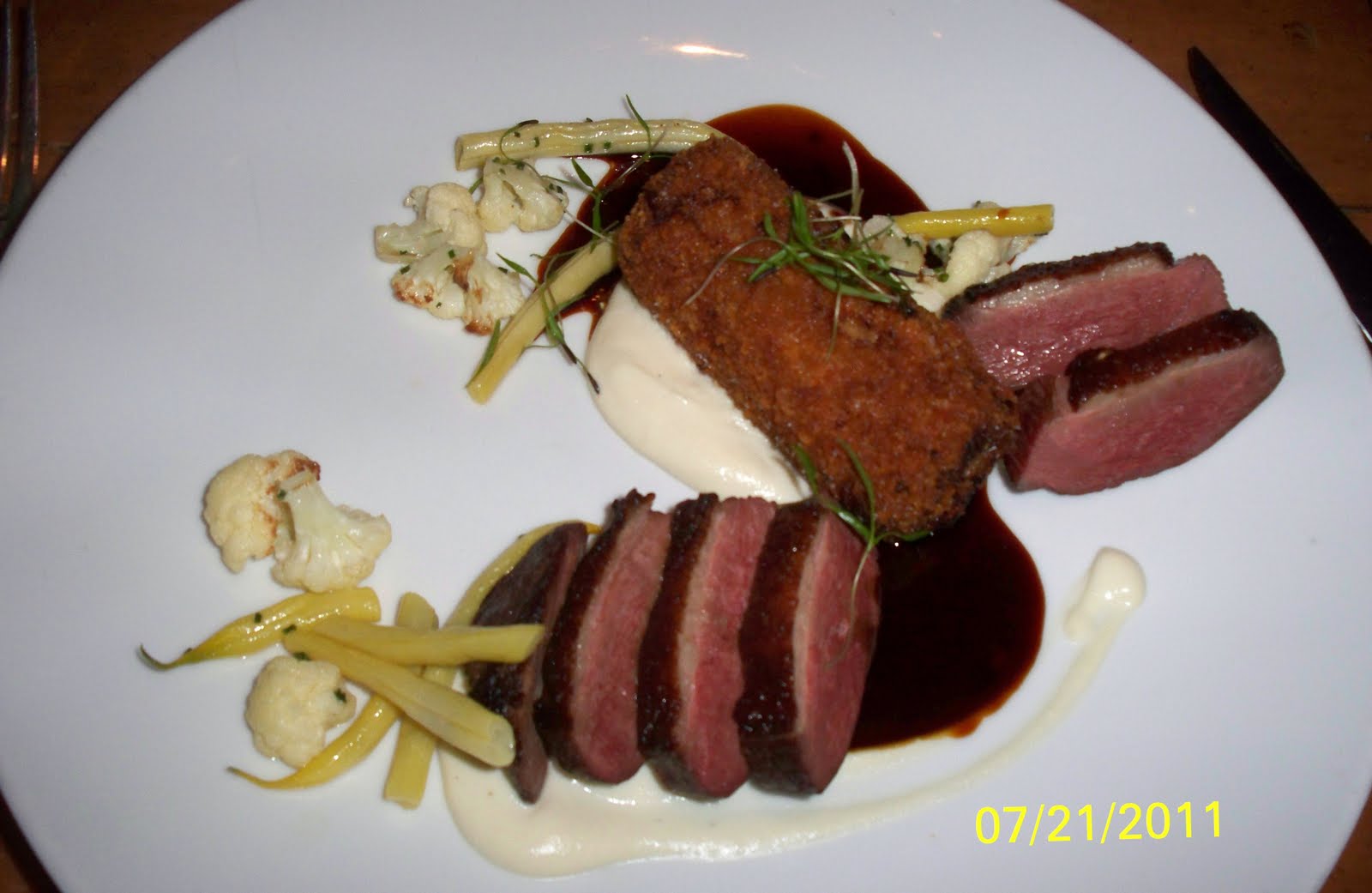
Dinner was fantastic. We had six guests join us at La Croix Restaurant in Center City Phillly. Our guest list included, Eli Lesser, who is in charge of summer programs at Penn, David Toomer, an Admissions Official from Penn, Ellen Kim, the Northern California Admissions Official at Penn, and three Penn undergrads: Sam, Britney, and Sean. I was lucky enough to be seated between Sam and Ms. Kim. Sam is an engineering major who will be entering Penn’s veterinary school once he graduates from his first four years as an undergrad. We conducted very interesting conversation regarding why Penn was an excellent college, the pros and cons of an urban campus, as well as how prospective college students are evaluated in their applications. I really enjoyed talking to Sam because he was easy to relate to. We have similar academic interests (except for the veterinary aspect) and I found our tastes in colleges to be very similar. Sam was a joy to speak with and he gave some excellent insight into the nuances of going to Penn. Ms. Kim was also very interesting to talk to. Having met her at the Exploring College Options seminar in Berkeley, she was very anxious to listen to my interpretations about the event. This branched off into discussion about the Ivy League Connection and what exactly it does for students and the surrounding communities. Of course, I was also able to slip in a few questions about Penn’s admissions process. Equally enjoyable to the conversation and company was the food at La Croix. This food was simply magnificent. I started with a corn soup, which an only be described as silky smooth. I also ordered duck as my entrĂ©e, which was oh-so succulent and tender. For dessert, I ordered a dish that was just called Blueberry. It was composed of blueberries, blueberry ice cream, chocolate mousse, and chocolate sauce. It was nothing short of divine. All in all, dinner was excellent and I could not have wished for better company.

Cohorts coming together.

There was quite an interesting conversation going on from the looks of things...

My spectacular duck...it still looks so good...

Matt is enjoying his conversation with Sam.

I wish today could have just felt a little bit longer. Our lectures this morning were very enjoyable (though one was especially confusing), we had a ton of fun at dinner, and I think the ILC has made a lasting impression on the University of Pennsylvania. Eli never ceases to be amazed with our program and he actually follows our blog, which surprised me at first (if you’re reading this, hi Eli!). These are the kind of networking opportunities and connections that we want to make as ambassadors and scholars. Our goal is to reach out to as many people as we are able to so that we can bring back as much information about college life as we possibly can for those who are unable to attend programs as magnificent as this one. Today, I was truly grateful for the opportunity that I have been given, and I can never thank all those involved in the ILC enough for letting me have the chance to embark on this journey and meet so many people that have changed my life.


One great big group shot to finish the night.

Great Advice

Today I was very glad to sleep in and get food at the local store instead of waking up early. I got a couple of bagels and some milk and walked out of the amazing air-conditioned store into some of the most intense heat I’ve ever endured. Sure, I’ve visited Death Valley in California where temperatures can hit in the 130® Fahrenheit, but the thing I’m not used to is the humidity and heat combination. I tried my best, but I was sleepy and unfocused for most of the day.

What made the day interesting was that we had two guest lecturers instead of one like the rest of this week. The first lecturer talked about space and particle cosmology. One of the side interests in science I have is astronomy, so I focused intensely as I tried to absorb what he was saying. Perhaps the most interesting thing that our first guest talked about was the effects of general relativity. After Einstein had his amazing year and came up with his theory of general relativity, people found it interesting, but his theories were really untested and therefore worthless until they were proven to accurately model nature. One of the coolest predictions of general relativity is that when there is a large amount of mass in between the observer and a light source behind the mass is that the mass will bend the path the light takes. Even cooler, when the observer, mass, and light source all line up exactly, the light is bended around and appears as a beautiful ring of the original source. When these rings were found, although it was many years after Einstein came up with his theories, general relativity was again proven to be a superior model to Newton’s “Law” of gravitation.

Dr. James Agurie was our second guest lecturer. James spoke primarily about his field, radio astrology. What is cool about radio astrology is that radio waves are a vastly different wavelength than light, so you can get very different properties of stars and other wave sources in space than with visible light. One of the interest groups in our class spent the last several days on the roof using a radio telescope to look at the sun. Anyways, radio astrology is pretty cool stuff, and I enjoyed James’ lecture a lot.

One of the things that I have discovered during my stay here at UPenn is that living independently makes it extremely easy to develop daily habits. While I am quite satisfied with my studying and social habits, one of my recent goals has been to begin learning Italian. After class, I headed to the Penn bookstore and purchased a Berlitz “Essential Italian” book to begin learning. The book came with an audio CD to follow along and learn how to properly pronounce all the words in the book that was quite useful.

I hung out with some friends in my friend Fred’s room for a while, and then it was time to get dressed up to go out to dinner. While wearing a black suit in the 95 degree heat wasn’t great, the dinner turned out to be fabulous. The restaurant we went to was in Center City Philadelphia, and it was called La Croix. The restaurant was located in a very fancy hotel and was right next to a beautiful courtyard. However, what made the meal fantastic was not the setting but the company. Charles was careful to have us each take seats next to people that we could learn a lot from. I was sandwiched between two current UPenn students. The first one that I met was named Sam Gilbert and the guy on my left was named Sean. I spent almost the entire meal conversing with Sam because, as I quickly found out, he had interests very similar to mine. At this moment, I am open-minded about where I’ll go to college, but the top of my list includes UPenn, MIT, Stanford, UC Berkeley and UCLA. I found out that Sam had been accepted to Columbia, MIT, and UPenn. Sam was kind enough to tell me that he chose Penn because he visited each campus and stayed overnight and that the UPenn students were extremely accommodating and friendly and that he instantly felt at home. Even better than having similar interests in colleges, Sam and I have very similar interests in academic subjects. At the moment, I am most strongly interested in a science major that will lead me down the path of researching or somehow being involved in the field of green energy. Sure enough, Sam turned out to have spent the last four years of his life studying Mechanical Engineering at UPenn and he was eager to tell me all about his program.

The first thing that Sam told me was that the engineering program at Penn still leaves you room to try some other classes for fun which he said was quite valuable to him. This sounded great to me because science is my primary interest, but I still want to study other things such as foreign languages. Another interest that Sam and I share is studying abroad. I absolutely want to study abroad while I’m in college, and Sam told me about how he spent time abroad during the summer which he thought was a nice fit for him because he didn’t have to interrupt his classes during the regular year. Beyond these things, Sam shared a ton of practical advice about housing, cooking, athletics, and just making the most out of his experience at UPenn. In fact, he had such a good time that he’s going to spend another 4 years getting a veterinary degree here. I very much appreciated Sam’s advice and friendliness, and I think conversing with him has been the most influential conversation I have had about college ever.

Wednesday, July 20, 2011

Relativity is Confusing...Relatively Speaking, That Is

Today was certainly out of the ordinary. Class had a different feel to it today and my time after class turned out better than I expected it to be. We started the day with a lab, which is very different from our usual schedule. We got together in our groups from the trip to Hershey to experiment. Our task was relatively simple. We had to balance a scale. However, this was no ordinary scale. This did not have a platform for weighing objects. Instead, it used metal rails for positioning very light objects (we used one-hundred milligram wires) and the scale was not used for weighing the objects we placed on it. Once the scale was balanced and hovering about a millimeter above the main body of the scale, we applied a current to the rails, which caused it to rise because there were two rails with opposing currents. Because the currents opposed each other, they were repelled. This would only happen if we applied a minimum amount of voltage so that the rails would repel so much that the top rail would overcome the forces that the wires pressed upon it. We found that the results supported our hypotheses. We observed that the amount of voltage needed would need to increase as the amount of weight on the rails increased.

Craig lectured us today and it was quite different from the lectures we have had before. Today’s topic was about General relativity. I was unaware that there were actually distinct categories of relativity, but it is actually divided into special relativity (which is what we covered previously) and general relativity. I was lost at the beginning of the lecture because the whole concept of the lecture revolved around idea that defied the theories and laws that we had learned before. Craig began by saying that general relativity was just geometry, but was a bit of a stretch. Although the ideas involved in general relativity are grounded in geometry, they quickly go against many of the fundamental ideas of the very same subject. For example, in geometry, the shortest distance between two points on a plane is a straight line. However, this is only if the case if the plane is flat. If a plane is non-Euclidian, which means that it is a curved surface, then the shortest distance between two points has to be a curved line, which defies THE most basic principle of geometry. As Craig continued the lecture, I began to grasp what he was discussing a little bit more, but I was still confused for the most part. It wasn’t until later that I was reviewing my notes with Brian that everything clicked. If you had told me at the beginning of this program that I would understand the ideas of relativity, I would have had my doubts. However, things have changed since the beginning of the Experimental Physics Academy. I have a stronger grasp on physics than I could ever gain after only a month of lessons.

Following Craig’s lecture was our guest lecture of the day. Today, Dr. Vijay Balasubramanian spoke to us about the biophysics of our brains. I find Dr. B’s background fascinating. He studied particle physics, cosmology, string theory, and several other areas of physics, but then decided to go into neuroscience. Although this was an interesting aspect of Dr. B, he was a very interesting lecturer as well. His style was energetic and he relied on volunteer participation, which is something I have not encountered in my few experiences with college professors and their lectures. The demonstrations he performed did help explain the material though. He gave specific instructions to pairs of volunteers that would be playing the parts of neurons in the brain. These instructions dictated how each pair would communicate with one another when a specific stimulus was applied. This demonstration was used to introduce us to just how the brain operates. This was part one of Dr. B’s lecture, which he called “How Brains Work.” Part two was called “Efficiency in the Brain” and covered statistics on how much energy and fuel the brain used to perform its work. The fascinating thing is, our brains consist of only two percent of our weight, but use up twenty percent of the metabolic load. It also uses only ten watts of power, which is about six percent the amount of energy per second of that used in a common light bulb. The third section of his lecture, “Can We Evolve to Be Smarter?”, covered the way we learn and how our minds came to be so advanced. Essentially, he informed us that our brains have (for the time being) hit an evolutionary roadblock. Right now, we do our learning through communication and synergy with others, not by enhancing how our brains operate. Our guest lectures continue to get more and more fascinating. I cannot wait to see what we learn about tomorrow.

After lunch we met in our special interest groups. Today, James took us to the roof of the Rittenhouse Labs to observe the sun through two different telescopes. We were actually able to see what we had been learning about for the past two days. The majority of our time on the roof was spent attempting to position the telescopes, one visual and one radio. Much to our surprise, it is not as easy to find the sun through the lens of a telescope as one may think. It actually took about twenty minutes to get a good image of the sun through the visual telescope. Once we had a good image, we were able to see a bright, orange ball emitting waves of heat. We were even able to get a view that was so magnified that we could see sunspots. Using the radio telescope was not easy in the slightest. It took a much longer time trying to get the telescope aligned. There were times when we would come close to getting the right angle, but then the graphs on the oscilloscope returned to normal after a few slight changes while the dish was moving. We spent over an hour trying to configure the telescope, when finally we got as close as we could to viewing the sun’s sound wave’s frequency output. Once we accomplished this minute feat, James informed us that we had just experienced several of the problems that come with using radio telescopes. There was a lot of interference from reflective objects in the area, which caused significant problems. The other major problem is the characteristics of the waves being used to receive the data. The waves are too spread out and are not specific enough to accurately pick up data from the sun, at least not from our location. Regardless of the problems, this experience was enlightening and I am learning through “failure.”


James staring at the sun...don't try this at home.

Our group of seven, Onur, Abheek, Alison, Julia, Fred, Brian, and I, decided to go to Center City Philly after our respective classes. We took the trolley and soon enough we were in the heart of Philadelphia again. We did not really have an agenda because we were just hoping to explore parts of Philadelphia as a group. We wound up getting some frozen yogurt, visiting the Comcast Building (which ironically looks like a phone jack), and eating dinner we picked up from a deli in the JFK Love Square. Our time in Center City was great, and it was definitely a different experience from when we rode a tour bus with Mr. Miranda three weeks ago.

Love, love, love...

The fountain/wading pool at Love Square

The Comcastic Phone Jack

My time here at Penn is dwindling. I only have ten days left in one of the greatest cities that I have ever visited. What is even more saddening is that I only have ten days left with some of the greatest friends I have ever made. Our time today at Love Square feels like it epitomizes the strong family-like bonds that we have forged over the past few weeks. We came together as strangers, but now we are the closest of friends and have made unforgettable connections. I pray that the next ten days are slow ones so I can enjoy the presence of my Philadelphia family that much longer.

I Want to be a Systems Neuroscientist When I Grow Up

Class today woke me right up (despite my late start) with a fascinating lab. We measured the distance between two balanced wires, hung tiny weights from them then ran opposite current through them until they balance again. Because we knew the length of the wires, the magnetic force needed to lift the weights, and the current we were able to calculate the constant for the permeability of free space, which is a very cool concept. Basically, what it implies is that a vacuum allows magnetic fields to emanate at a rate that is neither zero or infinity, meaning nothingness has properties of its own in a sense. As a follow up, we learned that the inverse of the square root of the sum of the permeability constant multiplied by the permittivity constant (involving electric charges rather than magnetic fields) is equal to the speed of light. This proves that light is an electromagnetic wave.


Next we sat through a lecture about general relativity, the concept that acceleration is equivalent to gravity within a single reference frame and that massive objects bent space, making euclidean geometry no longer applicable, which is what accounts for the planet's orbital motions and even, when studied further, mercury's irregular path. This lecture was fairly interesting, but honestly completely over shadowed by the presentation that followed.


Today's guest lecture was the most entertaining, excited and easily accessible speaker we have had so far. By a lot. He did not have power point slides that he simply read out loud. He drew on the chalk board, walked around, had us stand up and participate in his demonstrations in an incredibly engaging way. His name was Vijay Balasubramanian and his "lecture" (although it seemed like way too much fun to be called that) was about the physics of neuroscience. In the past he has done research in particles, cosmology, and string theory but today he talked mostly about the field he is currently doing work in, which is essentially how the brain works, and more specifically (which is what separates his field from biology) systems neuroscience: why it works the way it does.


He started the talk with a drawing of a neuron, a description of their structure and how dendrites and axons receive and transmit electrical signals. He then used volunteers to build a human neural circuit that displayed how the connections between the cells allow highly specialized cells to work together to do a broad variety of things. He lined up six students and gave them each a job (for example, if you see a white piece of paper, poke the person behind you or if you get poked raise your hand, etc.).


He also discussed with us the miraculous efficiency with which our brains operate. For example, only 10 watts is used to power it (as opposed to a standard 80 watt computer) and in one cubic millimeter of tissue, 4 kilometers of "wiring" can be found. He also mentioned that the rate at which signals are fired is only about 4 Hz, which is shockingly slow compared to a computer, but he discussed the drawbacks of having it go any faster: requiring more energy, a larger head, and not reaping proportionate benefits (as shown by the law of diminishing returns which basically states that double the information results in less than double the usefulness). It was really, really cool. So cool in fact that I cut my lunch time about half an our short to listen to him discuss how he got interested in his field and what more there is to discover in it (apparently a lot). He suggested we read the article in this months Scientific America about the limits of intelligence, in which he is quoted three times. I intend to do just that.


After lunch we went back to work collecting our single photon diffraction data and we've got a very nice looking graph to show for it now. We also started preparing for the presentation we are going to give next week. It should be cool telling our classmates the results of our lab and about how we proved particle/wave duality, but I am even more excited to hear what all the other groups have learned and maybe run across some Non Newtonian fluids.


After class, seven of us from my floor and Brian and Alex's floor signed out and looked around center city. We wandered for a while, grabbed some dinner at a sandwich shop and ate it next to a fountain that we were actually encouraged to dip our feet in. It was a great day and I'm really glad we finally got out to see the city.