Friday, July 29, 2011

The End of Days

I write today’s blog with a mixture of emotions. On one hand, I’m happy to be returning home to my family and friends. On the other hand, I’m leaving the “family” and friends that I have grown to know so well over the past four weeks. Tonight, the three of us departed from the quad, departed from our lives at Penn, and watched our Clique wave goodbye to us. The events of today were truly a great way to end the month.

We began class with our final presentations, our reports of the exponential physics experiments. These were, by far, the best presentations so far. All of the slideshows and presenters were entertaining, informative, and concise. Our presentation on Newton’s Law of Cooling, I felt, went exceptionally well. We had good background information, sufficient data, we came to the correct conclusion, and presented it in such a way that Bill and the TAs wholeheartedly agreed with our analysis and description. Ryan even told us that our analysis was exactly the way he would have taught the topic. This was comforting to hear since we did not have a lot of guidance with this experiment. The research, experiments, and presentation were largely left up to our decisions. To learn that we had come to the correct conclusion and that we taught the class the same way one of our instructors would was a great feeling.

Following the presentations, we had a long discussion on what could be improved in the program and what should be kept on for the next year. It was interesting to hear about what everyone thought about different aspects of the class. For example, I enjoyed hearing the opinions of people that had never taken physics before coming to the program. Most of them felt that the program was a great way to get involved in physics and that it was still a very educational experience, despite the pace. Even the students that have been taking physics for years said that the program benefited them immensely, and I could not agree with them more. I do not have any regrets or negative feedback for this program whatsoever. Everything was run excellently, Bill and the TAs were great, and the overall experience was one that I will never forget. I would highly recommend this course to anyone who is interested in pursuing science, and even to some who aren’t necessarily interested in taking that path.

After lunch, we all gathered in the small lecture hall on the ground floor of the DRL. This was the greatest part of today. We were told that this was Bill’s time to show off all of his best demonstrations. This was absolutely true. We were given quite the show this afternoon as Bill took us through the most entertaining demonstrations of physics he had to offer. He displayed the properties of elastic potential energy by sitting on a gigantic coil that was attached to the ceiling, blew up a small house using the flow of electrons through an unstable environment, and even shattered a wine glass using sound. Bill really pulled out all the stops today, and I couldn’t think of a better way to complete the course. After the demonstrations were over, we were given USB drives with everything that we could possibly want from the program. We received the slideshows from every lecture (guest and regular), well-known physics papers that were written by some of our guest lecturers, and even every single document and presentation that Mary uploaded to Dropbox. We were also given certificates of completion for the program and wooden stars that had C’s on them, as a testament to our ability to accurately measure the speed of light. Once Bill and Mary said all that they wanted to say, goodbyes, thank you’s and even some sorrowful hugs were exchanged between both classmate and staff. I made sure to say thank you and goodbye to Bill and all of the TAs before I left, except Adam, but he left early. It all felt complete after that.


I finally got my picture with Bill

Ryan was always a huge help and a pretty cool guy. Couldn't pass up a photo-op.

It was sad to say good-bye to Mary. We have grown close.

Coolest. TA. EVER.

Bill in serious clothing??

Once we returned to the dorms, I had to finish my packing. Somehow I managed to cram all of the things I brought and all of the souvenirs and gifts I purchased into my suitcase and suit bag. I couldn’t find a scale though, so I am really hoping that my luggage isn’t overweight. If it is though, I can always transfer some items from my suitcase to the suit bag, because that is definitely under-weight. I couldn’t wait to finish packing because I wanted to get as much time with everyone else as possible. Unfortunately, it took everyone quite a while to get everything packed, so we weren’t all finished until about 6:00. We decided to just get sandwiches from the convenience store near the quad and eat light, since we would be dancing later.

The dance began around 7:30 out in the lower quad. It was actually pretty funny because after about fifteen minutes of music, it began to rain. That was actually one of the hardest rains that I had experienced during my time at Penn. This put the party on hold for about fifteen minutes, but after that, it did not stop for another three hours. The music was loud, everyone was having a great time, and for a while we all let go of the fact that we would be leaving each other very, very soon.

At 10:10, Mr. Miranda arrived to sign us out. We didn’t actually leave the quad until at least half an hour later. It wasn’t that sign out took a long time, but our good-byes took a very long time. This would be the last time for a long time, if ever again, that the seven of us would be together, so it was all very emotional. I realized at that moment how attached I had become to my friends here. I knew that I would miss them, but I did not imagine that I would be so moved just by having to say goodbye. It truly is like ripping off a bandaid, you just have to do it quickly. Sometimes, that just isn’t possible. We were so unwilling to let go of each other. Several hugs were exchanged between each of us, touching parting words were said, and there was a universal need for tissues by the time we exited the front gates. Ed bid us adieu and we were officially out of Penn’s Summer Discovery experience.

This past month has been filled with fantastic events that I will always treasure. Whether it was meeting new friends or exploring the college that I may one day call my home, I never regretted coming to Penn, not for one second. I have never been more thankful to the Ivy League Connection, and everyone who supports it, than I felt today. Although I am sad to leave Penn and my new family behind, I am overjoyed to know that I have made life-long connections, and it wouldn’t be possible if it weren’t for this amazing program. I am forever indebted to the ILC for all that they have done for me. For my last time in Philadelphia, I’m signing off. Good night, and good-bye Philly.

Out With a Bang

The final day here at U Penn was both incredible and heartbreaking. During class, Bill showed us four hours worth of creative, informative, exciting and occasionally hilarious demos that he himself had designed. Our evening activity, a camp-wide outdoors dance, was especially fun as well (despite the rain). By the end of the night, when I realized the month was really over and I was going to have to part with the group of friends and classmates that I met, I came close to shedding tears.

The day started off in a typical manner. Wake up, shower, dress, and say goodbye to my roommate Noor before leaving for breakfast. Our goodbye today however was much more significant because it would be the last time we saw each other before the program ended (her flight was this afternoon). We exchanged e-mails and plan to keep in touch, but it is going to be difficult waking up in the morning without her motivational music. Not seeing her every day is going to be hard to get used to.

Class began normally as well. We started off giving out presentations about the exponential relationship between variables that we studied. Alex, Brian, Onor, and I gave our presentation about Newton's law of cooling based on the data we collected with our temperature probes in hot water last week. It was interesting giving a presentation about thermodynamics to fellow high school students because not long ago, for my final project in my physics class at ECHS, I taught a similar lesson to a sixth grade class. Needless to say, my presentation today required much less background information and repetition, but I still tried to present the ideas in a similar way - on a conceptual level rather than a repetition of textbook definitions, a technique that Bill has stressed the importance of throughout the course, and is very important to me as well.

After our presentations and a short lunch break, the really fun stuff began. We moved into a larger lecture room to watch Bill perform the number of demonstrations he had set up for us. Each one displayed a different concept that we had experience with either from earlier in the course or earlier years of science in an exciting way that often exposed new ways of looking at the laws they proved. It was awesome.Above is a photo of the first demonstration. It dealt with how objects float in environments with higher densities and sink when the density of the object is greater. If you look closely, You can see a bubble floating in the tank. He accomplished this by mixing vinegar and baking soda to create carbon dioxide that stayed in the tank because it was heavier than the surrounding air. When he blew bubble into the tank, the increased density resulted in a tank full of floating bubbles. It was really cool to watch. This demonstration was designed to show the effects of angular momentum. Because the wheel he is holding is spinning, the stool he is sitting on has the ability to spin, and together they are a closed system. Bill could make himself spin on the stool by changing the angle at which he held the spinning disk. The demo was especially interesting because he informed us that this is exactly how scientists steer the Hubble telescope.Next, he brought out a vandagraph generator and used it to show us the principles of static electricity. The example of his hair strands repelling each other as they picked up a charge was particularly amusing, but my favorite was the example of the stack of pie pans that flew off, one after the other, as soon as the machine was turned on.

Bill clearly is willing to go to great lengths to provide us visual, palpable examples when he hung himself from the celling on a spring to show us what oscillations look like. He even used a motion sensor hooked up to logger pro to show us the beautiful sine wave that results from harmonic motion in position, velocity, and acceleration. I addition to being highly entertaining, seeing Bill bounce up and down like that was actually helpful in understanding the system.
Some of my other favorite demonstrations included the one that described projectile motion. He posed the dilemma of wanting to shoot a monkey that lets go of the branch he is swinging from as soon as he sees that he is being shot at. Rather than aim below the monkey as one might initially think to do, parabolic motion says that it is best to shoot directly at the monkey because as the monkey falls, the bullet falls at the same rate. Bill created a rather ingenious contraption in order to demonstrate and prove this theory. He set up a blow gun with a metal piece fitted into the end. When he blows the bullet out of the tube, the metal piece is force out, breaking an electrical circuit that was magnetically suspending a toy monkey in front of the gun. With this setup, the monkey falls at exactly the same time the bullet leaves the tube. Bill aimed his gun directly at his target and hit the monkey every time.

The most exciting part was when he exploded a toy wooden house using an electrical current and a chemical mixture that created a reactive gas within the house. He showed us that when the house was electrically grounded with a lighting rod, nothing happened, but when that protection wasn't there, a boom loud enough to make my heart skip a beat and the entire class to jump about a foot in the air. It was quite a memorable demo.
When Bill ran out of demonstrations to show, or more likely, time with which to show them, we received our certificates of completion and a thumbdrive with all the links, slideshows, articles and contact information related to what we learned and who we met during the course. It is a huge amount of valuable information that will keep my busy for the remainder of the summer, and possibly year. We said our goodbyes and our "thankyouthankyouthankyou"s to all the teachers and staff that helped us learn the amazing things we learned this week and then went back to our dorms to pack.

Once our rooms were depressingly bare, we went out to the quad for the dance party. At first, people we a little shy. I got the feeling that many of them were more comfortable with equations that dance moves, but by the end of the night, we were dancing like crazy, screaming along to the music and enjoying ourselves as much as possible in order to squeeze every last drop out of our final night. By the end, I was exhausted and fulfilled. I knew that I had made the most not only of the evening, but of the entire month.

During the past four weeks, I have learned some of the most interesting concepts and met some of the most dynamic people I have ever learned or met before. It has changes the way I look about science and learning and given my some incredible tools that will allow me to continue to discover more throughout my life. I am incredibly grateful that the Ivy League Connection informed me of the program and enabled me to experience the fascinating world of experimental science.

Going out With a Bang

Today was really an interesting and emotional day. From the start, things felt a little bit different, but Alex and I did our usual routine and went to the bakery Au Bon Pain to get our breakfast. In class, we started off by doing our presentations on research that we did a week or so ago. In general, our assignment was to test different phenomena and to determine if they were exponential relationships or not. That sounds a little bit vague, so I’ll give examples of a few of the phenomena that groups tested. My group tested Newton’s Law of Cooling to see if it was an exponential relationship. Newton’s Law of Cooling basically describes how quickly a hot object will cool down in a cold surrounding medium and how a cold object warms up in a hot surrounding medium.

To test this relationship, we got several cups of water and heated about half of it. The first test that we did tested how a cold temperature probe warmed up in the hot water. We started our data collection, placed the probe in the water and waited for a couple minutes. As soon as we saw the graph of the temperature increasing, it seemed pretty clear that Newton’s Law of Cooling is an exponential relationship. To be sure, we tested our hypothesis out by using the software, Logger Pro, to do a curve fit of our data. The data fit very well with an inverse exponential function and we concluded that the relationship is exponential.

Several of the other groups had interesting presentations such as the group that tested a car that supposedly accelerated exponentially. Exponential relationships are very important in nature, so I was glad to get some exposure to a few of these phenomena. At lunch, I ordered some pizza and then realized that I had about $30 left on my Dining Dollars card. Luckily, Mary had mentioned that people could bring snacks for the afternoon lecture if they had dining dollars left so I bought a bunch of chips and soda to share. When I got back to class, we discovered that Mary had also made all of us cookies to enjoy while we watched Bill’s demonstration show.

Bill struck me from the start as a hands on kind of guy. I was definitely right, because Bill is in charge of making physics demonstrations at UPenn. Bill started off his demonstration by showing us examples of the buoyant force by showing us how regular soda sinks but diet soda floats because it’s less dense. Things quickly got better as Bill blew some bubbles in the air and pointed out that they always sink to the ground. Just as I was about to award him the Mr. Obvious award, Bill mixed up some baking soda and vinegar in an aquarium and then blew bubbles into it. Because the baking soda and vinegar react to make carbon dioxide, which is denser than air, the bubbles floated and bounced around in midair which was pretty cool.

Bill’s demonstrations got wilder and wilder as he began to well, blow stuff up. To demonstrate how well lighting rods work, Bill brought in a scale model of a typical home and filed it with a chemical that quickly converts into acetylene gas. With the lighting rod on the house, Bill shocked the house with an electric bolt but nothing happened because of the lighting rod. When he took the rod off and repeated the process, the house exploded into pieces and made a bang so loud I’m sure every person reading this blog heard it.

I loved Bill’s demonstrations, but the several hour show flew by in moments, and soon it was time to say goodbye. Mary showed us a final slideshow of everything we did and then gave us flash drives full of everything we’ve done in the last 4 weeks. Each of our teachers spoke for a little bit and I could once again see how dedicated each of them is to the program. I cannot express how thankful I am for Bill, Mary, Ryan, Craig, Adam, Brian, and everyone in the program for making the last 4 weeks so amazing and educational.

In the evening, we got to celebrate a little bit. Summer Discovery provided a D.J. for us and we had a fun, informal dance. The dance was really fun, but for me it was overshadowed by the fact that we had to leave at 10 o’clock. Finally, it was time to say goodbye to all of my friends that have made the last 4 weeks the best time of my life. I couldn’t stop myself from crying when I said goodbye to Fred, Abheek, Onur and Alison each of whom have been fantastic friends over the last 4 weeks. While I did cry a bit, I am reminded by one of my favorite people ever, Dr. Seuss, about how to deal with something like this.

“Don’t cry because it’s over, smile because it happened” ~Dr. Seuss

With modern technology, there’s no excuse not to stay in touch, so I know we will continue to be great friends even as Onur heads back to Turkey, Abheek back to London, Alison back to Florida, and Fred back to Alabama.

Thank you to everyone in this program for making it such a great experience.

Thursday, July 28, 2011

A Guided Tour of the World of Experiments

Time has gone by so quickly! I am still in shock that tomorrow is my last day of class. Even thought we are so close to the end, we continue to learn more about the way experimental physics works in the real world. One thing that has changed in the final couple days is that we are beginning to learn about it from many different sources. In addition to the guest lecture today I heard from my fellow classmates (and got to teach them a thing or two myself) as well as some of the grad students that populate the basement of our building, working on some groundbreaking studies with radio telescopes, carbon nano-tubes, and soft matter.

The day started off with a very interesting guest lecture about the construction of SNO (Subdury Neutrino Observatory), a huge neutrino detector placed at the bottom of a nickel mine to shield it from unwanted background information. By studying these subatomic particles that can travel the distance between us and the sun in just over eight minutes, we can learn a lot about the nuclear reactions occurring at the suns core currently. It turns out the data also proves the Standard Sun Model, which had previously been questioned because previous experiments did not account for oscillations that can change the "flavor" of neutrinos. The most interesting part of the lecture for me was seeing the journey from the first detector that failed to collect conformational data and the confusion that insued, to the construction of SNO and the steps that led scientists there. That is truly what experiments are all about: dealing with confusion.

Another great part of the day was listening to the experiences and findings of the classmates who worked on different interest groups than me. Groups gave presentations on cloud chambers, measuring cosmic rays, using radio telescopes, and a number of other really fascinating things. Something really exceptional about the presentations was not the data they got (although sometimes, when they came really close to the accepted value that was also neat) but the experimental process that each group preformed, and in some cases designed.


To be completely honest, my favorite part of the presentations was the part where my group got to share our experience with quantum mechanics and electron/photon diffraction. It was a really cool feeling being able to tell a group of people about the data that we collected ourselves and the significance of it, especially because particle/wave duality is such a mind-bending phenomenon that is crazy just to think about, let alone explain. My group faced the challenge quite elegantly and we sat down knowing that each of our peers knew a little bit more about the amazing concept that we could prove with our own data.

After lunch, we went on a tour of the grad labs, which gave me more of an idea of what the field of physics actually looks like than anything we've done in class before. Young students with excited smiles and scraggly beards showed us the equipment they worked with and explained to us why they were interested in the field they were currently researching. It was clear it was a lot of hard, and possibly tedious work, but it was also clear that each of them was genuinely excited about what they were doing and confident that the work they were doing was both significant and completely awesome. It was an environment I can see myself fitting right into.

Our PENNultimate Day

Today was exciting from the start because we began our class with a talk with Rick Vanberg. For the first few minutes I munched on my bagel and listened, but soon his talk became quite captivating. The first thing that Rick talked about was the standard nuclear model for the sun. Based on the observations of nuclear activity on small scales, scientists came up with a model that accounted for the gravity, high pressure, and high nuclear activity in the center of the sun. One problem was that the accepted model at the time predicted a large number of neutrinos would be released for every fusion reaction in the sun.

Because there are so many reactions every second, scientists predicted a certain number of neutrinos per second would hit each meter of the Earth’s surface. To test this model, a scientist filled a large vat full of liquid and then waited for a while. Although the experiment was underground, neutrinos are tiny and have no charge so they very rarely interact with the matter in the way. When the neutrinos strike the liquid, they are absorbed and they change the atom that they strike into a different element. When he took the measurements of the number of neutrinos that he detected, he found that there were only about 28% of the neutrinos that there should be.

To solve this conundrum which either implied that our model of the sun was totally wrong or that we didn’t understand neutrinos, a Russian scientist stepped up to the plate. Communicating through the veil of the Iron Curtain, this scientist published several papers where he claimed that we misunderstood the neutrino. To test this claim, a project called SNOW was developed. Snow basically consisted of a huge neutrino detector built to detect all kinds of neutrinos unlike the past models. To filter out background radiation, SNOW was built 2 kilometers beneath the surface of the Earth in a nickel mine in Ontario. SNOW ended up successfully measuring all of the neutrinos that came from the sun and we learned that the neutrinos were being morphed into other flavors and that the nuclear model of the Sun is actually correct.

Next on our schedule were the student focus group presentations. Each of us spent 4 days last week with our groups researching a subject that we picked. My group studied a non-Newtonian fluid called oobleck which basically means that it is a material that behaves both as a solid and a liquid. The peak of our presentation was on Monday when we used the oobleck in a demonstration. Because oobleck acts a solid when it’s under pressure, each of us could run over it. Today, we showed some graphs of how objects decelerate when they hit oobleck compared to when they hit water. The graphs were neat because you could really see how the oobleck gave away for a moment and then hardened and stopped the incoming solid whereas the water allowed the object to easily pass through. It would be way too much to talk about every other group’s presentation, but they covered many amazing topics such as quantum mechanics and radio astronomy. Each group had a unique perspective to offer and we all learned a lot from each other.

When we returned for lunch, we got to do something pretty interesting. We split into groups and then visited different parts of our building and the one across the street. We got to go into research labs and listen to brief talks by the researchers themselves about what they were working on. The first lab we stepped into was a lab where a grad student and a professor from UC Santa Barbara (WHOO California) were developing technology for better mammograms. Because current mammography methods require the breast to be squished tightly between pressure plates so that the waves could get better images, these researchers were searching for a way to do mammograms with near infrared light. The advantage of this is that the discomfort of the plates could be avoided and therefore more women might show up for their mammograms. I was impressed by how applicable this research seemed and that it truly was for a good cause. We heard many other talks about great stuff like carbon nano tubes and grapheme. These researchers were researching grapheme so that they could manufacture tiny detectors for things such as bomb detection. Overall, I was very impressed by how passionate these researchers were about their areas of study.

I am in shock that tomorrow will be my last day here at UPenn, but who knows; maybe I’ll be able to spend another 4 years here.

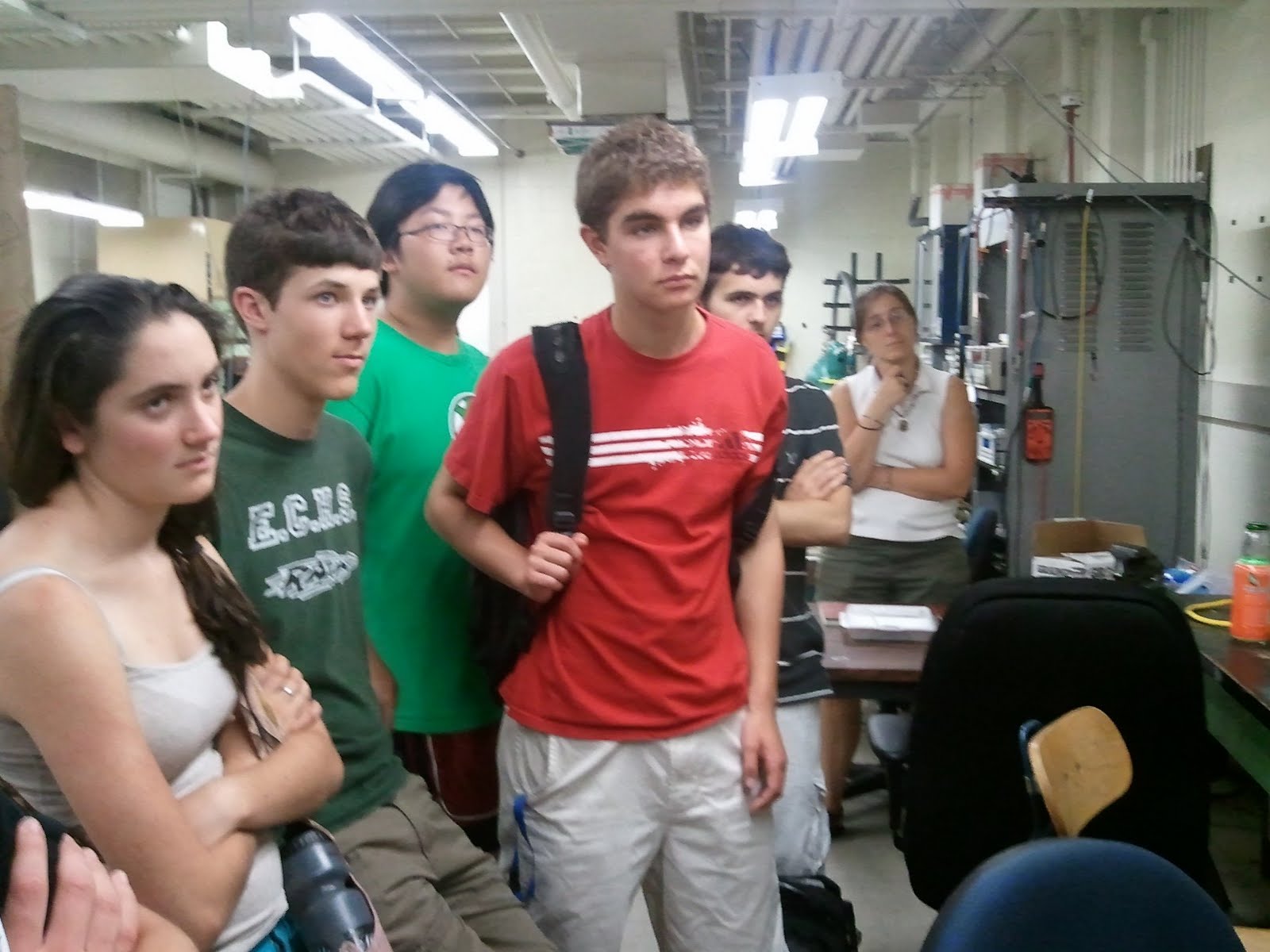
Thanks to Alex for capturing Julia's momentary lack of enthusiasm.

The Day is Almost Here...

Today was much less intense than the past couple of days. We began with a lecture from a well known particle physicist, Rick Van Berg. Rick primarily designs detectors for particle physics experiments. He has done a lot of work in the Cern Laboratories in Switzerland, home to the smartest scientists of this age and the best particle accelerator in the world. Lately, he has been working in the SNO facilities in Ontario, Canada. SNO stands for Sudbury Neutrino Observatory and it too is one of the best research facilities in the world. His lecture was actually all about Neutrinos, which is a basic particle that usually travels close to the speed of light, can pass through most matter unaffected, and is electrically neutral. He discussed the origins, discovery, and research of neutrinos and it was all fascinating. For instance, the SNO facilities are basically giant clean rooms, much like facilities in which they produce computer chips in. Professor Van Berg told us that if even a teaspoon of dust were to be introduced to the facility, every project would be ruined. I always find the stipulations that are put on certain research environments interesting. I like seeing all the effort that scientists and researchers are putting in to reduce their possibility for error as much as possible. Professor Van Berg covered one of the more difficult and complex lectures, but his was much more understandable than some of our other lectures.

After lecture, we continued with our presentations. I was very excited to watch these demonstrations because I wanted to see what kind of work my friends and peers had been doing for a week. I was also anxious to see how our data and experiments would stack up against theirs. When it came down to it though, our topic was quite different than most of the other groups’. While most of the other groups were doing experimentation for the majority of the week, we were being given lectures about radio astronomy and the tools used to study it. This was completely understandable though. Although we did not do many experiments, we needed to know how everything worked before we could understand what exactly we were doing before we could actually do it. This really made our presentation stand out because our data section was short, but our general and background information was much more extensive than the other groups’. Mary told us at the beginning of lunch that she though our presentation was a nice change from the rest and that our information was plentiful and well-organized.

Following lunch, we split into four groups to tour different labs around DRL. I didn’t realize that there were so many different kinds of research going on in the DRL. We visited medical labs, cosmology labs, and even soft-condensed matter labs, which deal with matter that has both the properties of liquids and solids. Mostly, we spoke to grad students that were doing research in the lab. They were able to tell us all about the projects they were working on. One of the most interesting projects we saw (in my opinion anyway) was a machine that was being developed that would use near-infrared waves to sense tumors. The research was mostly focused on improving scans for breast cancer, but it was also applicable to scanning other tumors and also brain activity. It was truly amazing work. Of course each of the labs was showcasing the best of what they were working on and each of them told us why their specific field of research was one of the best. It was interesting to hear about the different research styles and opportunities that all of these grad students have. It was even better to hear that undergrads are also allowed to study in these labs and perform research. Our visits to these labs were truly enlightening because it gave me an even better glimpse of what kind of research opportunities I could potentially have in college.

Sample data collected by grads and undergrads

Professor Van Bern discussing ATLAS, another project he worked on

After class, I continued packing a little bit. I’ll finish tomorrow before the room check, but it’s definitely not something that I am looking forward to. Once 6:00 came around, my floor and our RC, Carlos, went out to Bobby’s Burger Palace for a group dinner. Apparently the Bobby, after which this restaurant is named, is THE Bobby Flay. I didn’t realize this until we walked inside and there was a whole section of the counter dedicated to Bobby Flay marinades, spices, and cookbooks. The food was amazing as well. It was just a burger and fries, nothing too extravagant, but it was just so delicious. The burger was cooked to perfection and the fries were perfect. I couldn’t imagine a better way to come together as a floor. We all took a group picture out front, but we only had time for one shot because we had to be back at the quad as a group before a certain time. Unfortunately my camera was not the one used, but my friend and floormate Sachit’s. He will be uploading the picture to Facebook soon and I will be sure to use the shot in my reflection blog.

Everyone approves of Bobby's


We returned to the quad and got as much of the group together as we could. Since this is our last full night here at Penn, we wanted to enjoy our final moments hanging out in our lounge-like dorm. Although Fred, Abheek, and Julia were busy, Alison, Brian, Onur, and I still had a great time. We talked, we laughed, but most importantly we just enjoyed each other’s company. Being together in the dorms and lounges is what I’m going to miss the most about being at Penn. These nights were often the highlights of my days and I will always treasure the moments I’ve had in our little family of seven. The end is near.

One day remains.

A different take on Vettriano...

Wednesday, July 27, 2011

A Unifying Theory

We got right to work today with a morning lecture about nuclear physics from Ryan, one of the very helpful and knowledgeable assistant teachers. The first couple slides were about the history of nuclear energy and the discovery of x-rays. Ryan went on to explain the physics behind alpha decay, beta decay, and gamma radiation (during this part of the presentation, our previous lecture about the standard model came up again and it was necessary to recall the concept of leptons and quarks). The remainder of the lecture was devoted to explanation of applications of radiation that are highly important both within and independent of the realm of physics. We discussed the benefits and waste products of uranium mining, the breakthroughs and limitations of radiation as a cancer treatment, briefly touched on the subject of mass spectrometry and how radiation can be a helpful tool in studying the origins of the universe. Towards the end, the lecture transformed into more of a discussion that was so lively and obviously relevant, that I found myself more engaged than I had been during any previous first-thing0in-the-morning lectures.

After Ryan's talk, we were given a short break to let the information soak in a little and to give us time to prepare for our presentations of the Hershey Park Rides. It was a very different experience hearing from groups of fellow classmates as opposed to professors and teachers. Each group went on a different ride, so the data was unique in that regard, but each team's presentation and analysis of data varied greatly as well. Some groups were able to record videos and sync them to their data, others calculated the resultant total acceleration based on the x, y, and z values they collected. One group even had a three dimensional animation of altitude v. y acceleration v. time. By the end of the day, I had learned a lot from my fellow class mates about creative ways to handle data in a way that makes sense to your particular experiment and goals.

When all the presentations were over and we returned from our lunch break, we prepared for our guest lecture by watching "Elegant Universe", the PBS show on string theory. As I was watching, I realized that I had seen parts of the show before; my fifth grade teacher played if for our class. At that time it had come out only a few months ago. I remembered the movie distinctly because it was a moment in my life when I realized both how incredibly cool science could be, and at the same time, how very little I understood about the complexities of it. Watching the film this time around, I understood many more of the concepts, but the sense of wonder was not lost.

Only moments after watching the program he was quoted in, we got to hear from string theorist Burt Overt himself. He described to us, in much greater detail than the movie, the basic concepts of string theory, the implications that the theory has, why it makes sense in the real world, and the ways in which it can be tested.

The basic definition of string theory is the hypothesis that the smallest components that make up the universe are not particles but tiny strings that vibrate at different frequencies to create different kinds of matter. The mathematical calculations that have been done suggest that such a theory means that there must be 6 other dimensions besides the three spacial dimensions and time. The concept of extra dimensions is a hard one to grasp, but it made more sense to me today than it ever has before when Dr. Ovurt did a demonstration with a rolled up piece of paper. Another implication of string theory he discussed was the concept of supersymmetry, meaning that for every particle, there is a so-called "sparticle" that also exist. These particles have yet to be found because they do not appear in low-energy circumstances, but Ovurt has high hopes that CERN will provide the environment necessary to make significant breakthroughs in the subject.

It was fascinating listening to an expert talk about a field that is at the very outer edges of the scientific frontier. The fact that people in the class asked questions that no one in the world has answers to, but that Ovurt is actively working on discovering was almost too much to comprehend.

After class, we had a few hours to wander campus before we went out to dinner with Mr. Miranda and the Yale chaperone. We ate at City Tavern, a place I had been interested in visiting since our initial tour of the city. The food they serve is all based on the typical cuisine of the taverns of the 18th century that our country's founders used to eat. While we munched on some sweet potato pecan rolls (apparently one of Thomas Jefferson's favorites) we discussed not the past, but the future: our plans for senior year, applying to colleges etc. When dinner was over, we visited an ice cream parlor, a great end to one of my last days here at Penn.